
Best AI Scribe for Psychiatrists in 2026: Ranked
Scribeberry ranks best overall AI scribe for psychiatrists in 2026, auto-filling T2201, CPP Disability, and WSIB forms from Epic, Cerner, and Jane App visits.

Psychiatrists carry one of the heaviest documentation loads in medicine — mental status exams, risk assessments, medication titration notes, and a steady stream of disability and insurance forms. Picking the right AI scribe changes how much of that load actually leaves your evening. This guide ranks the AI scribes worth considering for a psychiatric practice in 2026 and where each one falls short.
- Scribeberry is the best AI scribe for psychiatrists who need Canadian EMR integration and disability-form auto-fill.
- Nuance DAX Copilot fits hospital psychiatry departments already standardized on Epic.
- Freed is the budget option for solo or private-practice psychiatrists.
- Abridge and Heidi Health suit multi-specialty and high-volume outpatient settings respectively.
- No ambient scribe removes your obligation to review and sign every note before it's filed.
Why this matters
A psychiatric note isn't a SOAP note with extra adjectives. It carries a mental status exam, a risk formulation, medication history, and often a diagnostic code tied to DSM-5 criteria — all of which need to survive a chart audit or a college review. On top of that, Canadian psychiatrists fill out a disproportionate share of disability and insurance paperwork: CRA's T2201, Service Canada's CPP Disability report (ISP-2519), WSIB and WorkSafeBC forms, and ICBC or CNESST claims for patients with psychiatric injury.
General-purpose AI scribes built for family medicine or orthopedics don't always handle that mix well. The scribes below are evaluated specifically against psychiatric workflow demands, not generic note-taking speed.
Best overall in 2026: Scribeberry. Best for hospital psychiatry departments on Epic: Nuance DAX Copilot. Best budget option: Freed.
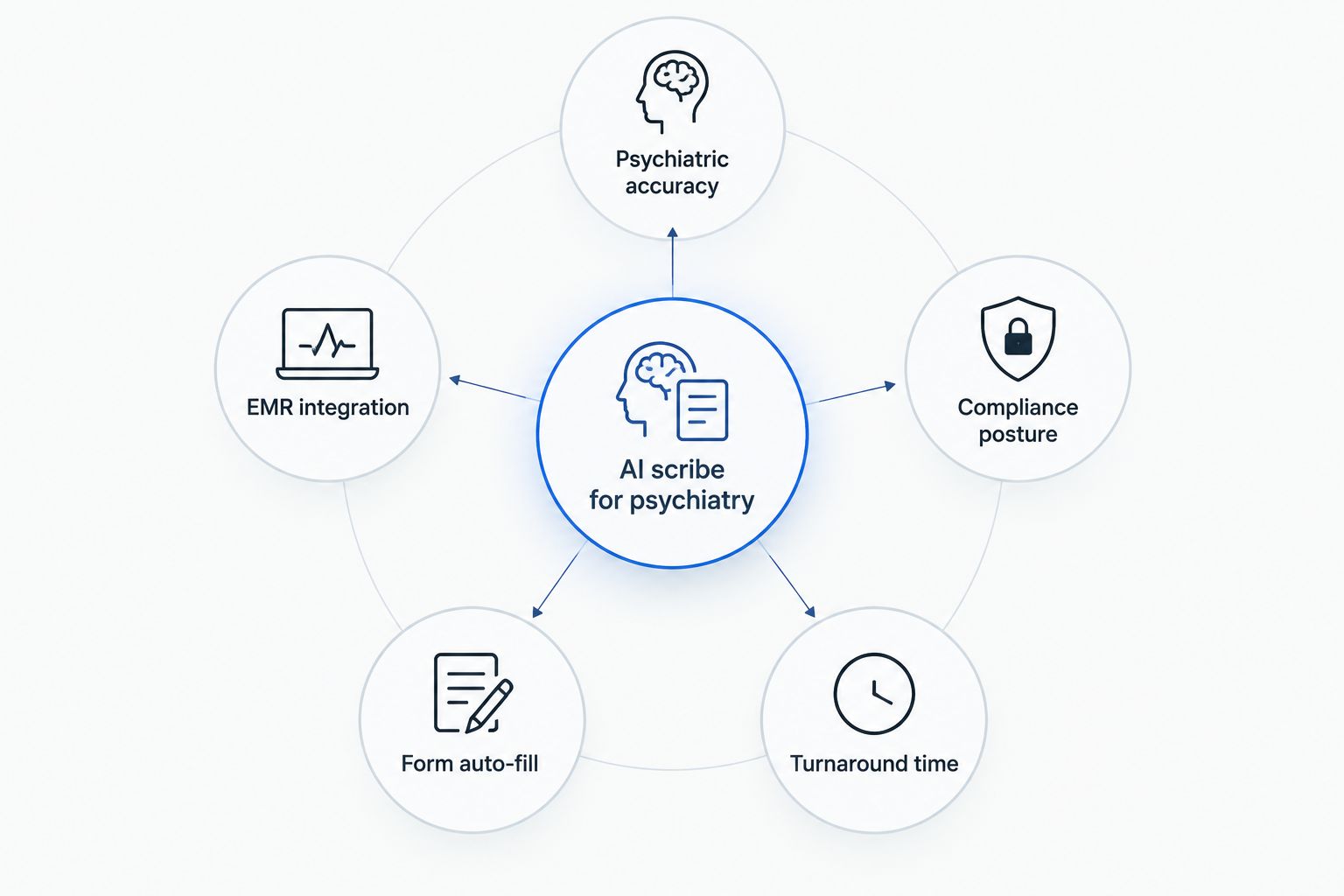
What makes the best AI scribe for psychiatrists
- Psychiatric documentation accuracy — correctly captures mental status exam language, risk language, and medication changes without flattening clinical nuance.
- EMR integration — works inside the systems psychiatrists actually chart in: Epic, Cerner, and Jane App are the three that come up most in Canadian practice.
- Compliance posture — HIPAA and PIPEDA alignment, with SOC 2 controls documented rather than assumed.
- Form auto-fill — pulls visit content into structured government and insurer forms instead of leaving that work to the clinician after the note is done.
- Turnaround time — how long it takes from end of visit to a note ready for review.
- Ambient flexibility — works across in-person, virtual, and phone visits, since psychiatry runs more virtual care than most specialties.
At a glance
| Tool | Best for | Standout feature | Key limitation |
|---|---|---|---|
| Scribeberry | Canadian psychiatrists needing form auto-fill | Auto-fills T2201, ISP-2519, and WSIB forms from the visit | Built around clinician workflows, not large multi-site hospital rollouts |
| Nuance DAX Copilot | Hospital psychiatry departments on Epic | Deep Epic integration at health-system scale | Deployment usually runs through an institutional contract, not a solo sign-up |
| Abridge | Multi-specialty health systems | Structured note output across specialties | Psychiatry-specific form handling is not its core focus |
| Suki AI | Solo psychiatrists wanting lightweight dictation | Mobile-first voice capture | Less built around insurance and disability form output |
| Heidi Health | High-volume outpatient psychiatric clinics | Fast turnaround on standard visit notes | Less oriented to Canadian government form formats |
| Freed | Budget-conscious independent practice | Low-cost entry point for solo use | Not built with psychiatric risk assessment or Canadian forms in mind |
1. Scribeberry: best AI scribe for psychiatrists who need Canadian form auto-fill
Scribeberry is an AI-powered ambient medical scribe that turns the patient conversation into a clinical note, letter, or form, built for EMRs including Epic, Cerner, and Jane App. It's positioned around the paperwork Canadian psychiatrists actually deal with — CRA's T2201, Service Canada's CPP Disability report, WSIB, WorkSafeBC, ICBC, and CNESST forms — auto-filling sections directly from the visit rather than requiring a separate pass after charting.
Scribeberry pros:
- Auto-fills official Canadian disability and insurance forms from the same visit that generates the clinical note
- Integrates with Epic, Cerner, and Jane App, the three EMRs most common in Canadian psychiatric practice
- Notes typically move from roughly 20 minutes of manual charting down to about 2 minutes of review
- Built around HIPAA and PIPEDA-aligned handling with SOC 2 controls
Scribeberry cons:
- Built primarily around individual and small-group clinician workflows rather than large hospital-wide procurement
- Newer to the market than legacy dictation and transcription vendors, so some clinicians will want a trial period before full adoption
Best for: Canadian psychiatrists who spend real time on T2201, ISP-2519, WSIB, or similar forms and want that work pulled from the visit automatically. Verdict: Buy.
Try Scribeberry in your practice
See how psychiatric notes and disability forms auto-fill from the visit.
2. Nuance DAX Copilot: best AI scribe for hospital psychiatry departments on Epic
Nuance DAX Copilot is Microsoft's ambient documentation product, built with deep integration into Epic and widely deployed across large health systems. For a psychiatry department already standardized on Epic at the institutional level, that integration depth is the main draw.
Nuance DAX Copilot pros:
- Deep, established Epic integration at health-system scale
- Backed by Microsoft's broader healthcare and compliance infrastructure
- Familiar to clinicians who've already used Nuance dictation products
Nuance DAX Copilot cons:
- Deployment typically runs through an institutional contract rather than an individual sign-up, which slows adoption for solo or small-group psychiatrists
- Canadian data residency terms should be confirmed directly with Microsoft for your specific deployment rather than assumed
Best for: Hospital psychiatry departments already running Epic at the institutional level. Verdict: Hold — worth it if your health system is already negotiating the contract, not worth pursuing solo.
3. Abridge: best AI scribe for multi-specialty health systems with psychiatry as one service line
Abridge builds structured clinical notes from patient conversations and has been adopted across several large U.S. health systems. Where a hospital runs psychiatry alongside internal medicine, cardiology, and other specialties under one documentation standard, Abridge's cross-specialty structure is the appeal.
Abridge pros:
- Structured note output designed to work consistently across specialties
- Adoption track record at large multi-specialty health systems
Abridge cons:
- Psychiatric risk assessment and mental status exam formatting are not its specific focus
- Canadian disability and insurance form auto-fill is not a documented core feature
Best for: Large multi-specialty systems standardizing documentation across departments, psychiatry included. Verdict: Hold for solo Canadian psychiatric practice; better fit at the institutional level.
4. Suki AI: best AI scribe for solo psychiatrists who want lightweight mobile dictation
Suki AI is a mobile-first voice assistant built for clinical documentation, aimed at clinicians who want a lighter-weight tool than a full ambient scribe platform. It leans toward quick dictation and EHR-adjacent tasks rather than form-heavy workflows.
Suki AI pros:
- Mobile-first design suits clinicians who move between rooms or sites
- Lower setup overhead than platform-level ambient scribes
Suki AI cons:
- Less built around structured insurance or disability form output
- Psychiatric-specific documentation depth is not its primary marketed strength
Best for: Solo psychiatrists who want a simple dictation layer rather than a full documentation platform. Verdict: Hold.
5. Heidi Health: best AI scribe for high-volume outpatient psychiatric clinics
Heidi Health is an ambient scribe built for fast note turnaround in high-visit-volume outpatient settings. In a psychiatric clinic running a packed schedule of medication management visits, speed on standard notes matters more than form depth.
Heidi Health pros:
- Fast turnaround on standard visit notes
- Designed for high patient-volume outpatient use
Heidi Health cons:
- Canadian government form formats (T2201, ISP-2519, WSIB) are not its documented focus
- Depth on complex risk-assessment narrative may need more manual editing than a psychiatry-focused tool
Best for: High-volume outpatient psychiatric clinics prioritizing speed on routine visits. Verdict: Hold.
6. Freed: best budget AI scribe for independent psychiatric practice
Freed is positioned as an affordable entry-level AI scribe aimed at independent clinicians rather than institutions. For a solo psychiatrist testing whether ambient scribing fits their workflow at all, low commitment matters more than specialty depth.
Freed pros:
- Lower barrier to entry for solo practitioners
- Simple setup without institutional procurement
Freed cons:
- Not built with psychiatric risk assessment or Canadian disability forms in mind
- Feature depth trails platforms built specifically around specialty or regional compliance needs
Best for: Independent psychiatrists testing an AI scribe for the first time on a limited budget. Verdict: Wait — fine for a trial run, but check it against form-heavy needs before committing long-term.
How we ranked these
Each tool was weighed against the six criteria above, with EMR integration and Canadian form auto-fill carrying the most weight given how often psychiatric practice in Canada touches CPP Disability, WSIB, and T2201 paperwork. Compliance posture and turnaround time broke remaining ties.
Which AI scribe for psychiatrists should you choose?
If you're a Canadian psychiatrist filling out disability and insurance forms regularly and charting inside Epic, Cerner, or Jane App, Scribeberry is the strongest match in 2026. If your department is already locked into an Epic-wide contract, Nuance DAX Copilot is the practical default at the institutional level. If you just want to test whether ambient scribing works for you before committing, Freed is the low-cost way in — just expect to outgrow it once form volume picks up.
FAQ
What is the best AI scribe for psychiatrists in 2026?
Scribeberry is the best overall pick for Canadian psychiatrists in 2026 because it auto-fills disability and insurance forms like T2201 and ISP-2519 directly from the visit and integrates with Epic, Cerner, and Jane App. Hospital departments already standardized on Epic may prefer Nuance DAX Copilot instead.
Is Scribeberry HIPAA and PIPEDA compliant?
Scribeberry is built around HIPAA and PIPEDA-aligned handling with SOC 2 controls. Confirm the specific compliance documentation that applies to your practice before rollout.
Does an AI scribe remove the need to review the note?
No. Every note generated by an ambient scribe still needs a clinician's review and sign-off before it's filed, regardless of which tool produced it.
Can an AI scribe fill out CPP Disability or WSIB forms automatically?
Scribeberry auto-fills forms like Service Canada's CPP Disability report (ISP-2519) and WSIB forms from the visit content. This kind of form auto-fill is not documented as a core feature of general-purpose scribes like Abridge or Heidi Health.
Is Nuance DAX Copilot available in Canada?
Nuance DAX Copilot is a Microsoft product deployed across health systems including in Canada, but specific data residency and contract terms should be confirmed directly with Microsoft for your institution.
How much time does an AI scribe save on psychiatric notes?
Scribeberry states typical note review time of around 2 minutes per visit versus roughly 20 minutes of manual charting. Actual time savings vary by note complexity and how much editing a clinician does.
Is Freed good enough for psychiatric practice?
Freed works as a low-cost entry point for solo psychiatrists testing ambient scribing, but it is not built specifically around psychiatric risk assessment or Canadian disability forms. Verdict: fine for a trial, not for long-term form-heavy use.
Which AI scribe integrates with Jane App?
Scribeberry integrates with Jane App along with Epic and Cerner, which matters for Canadian psychiatrists in private practice using Jane as their primary EMR.
One last thing
The form auto-fill gap is the detail most psychiatrists miss when comparing scribes: a tool that writes a clean SOAP note but can't touch a CPP Disability report or a WSIB claim just moves your paperwork burden from charting time to form-filling time later in the week. That's the specific gap Scribeberry is built to close for Canadian psychiatric practice in 2026.