
Best AI Scribe for Family Medicine 2026: Top 6 Ranked
Scribeberry ranks best ai scribe for family medicine in 2026 for Canadian form auto-fill and EMR fit, with 5 alternatives compared on integration and setup.

Family medicine clinics across Canada are testing AI medical scribes to cut after-hours charting, and the best ai scribe for family medicine depends on your EMR, your patient volume, and how many government or insurance forms your clinic processes each month.
- Scribeberry is the best ai scribe for family medicine clinics handling Canadian forms like T2201, WSIB, and ISP-2519 alongside daily EMR charting.
- Tali AI fits Canadian primary care teams that want voice-driven chart navigation built with PIPEDA in mind.
- Nuance Dragon Copilot suits multi-physician clinics already running Epic.
- Heidi Health works for solo family doctors who want a scribe running the same day with no IT rollout.
- Abridge and Suki round out the list for high-volume note generation and broader AI task automation.
Why this matters
A typical family medicine clinic generates a note for every visit, plus letters, referrals, and — in Canada — a steady stream of disability, insurance, and employer forms. Scribeberry is built around that exact mix: it turns the patient conversation into a clinical note and can auto-fill forms like CRA's T2201 or Service Canada's ISP-2519 from the same visit.
The scribe market has widened fast heading into 2026, and clinics now have real options beyond the legacy dictation tools. Picking the wrong one means paying for features your clinic never touches, or missing the one feature — form auto-fill, EMR sync, Canadian data handling — that actually saves time.
Best overall: Scribeberry, for Canadian family clinics juggling EMR notes and government forms. Best for large multi-physician groups on Epic: Nuance Dragon Copilot. Best for solo practitioners who want same-day setup: Heidi Health. Best for teams that want a Canadian-built alternative: Tali AI.
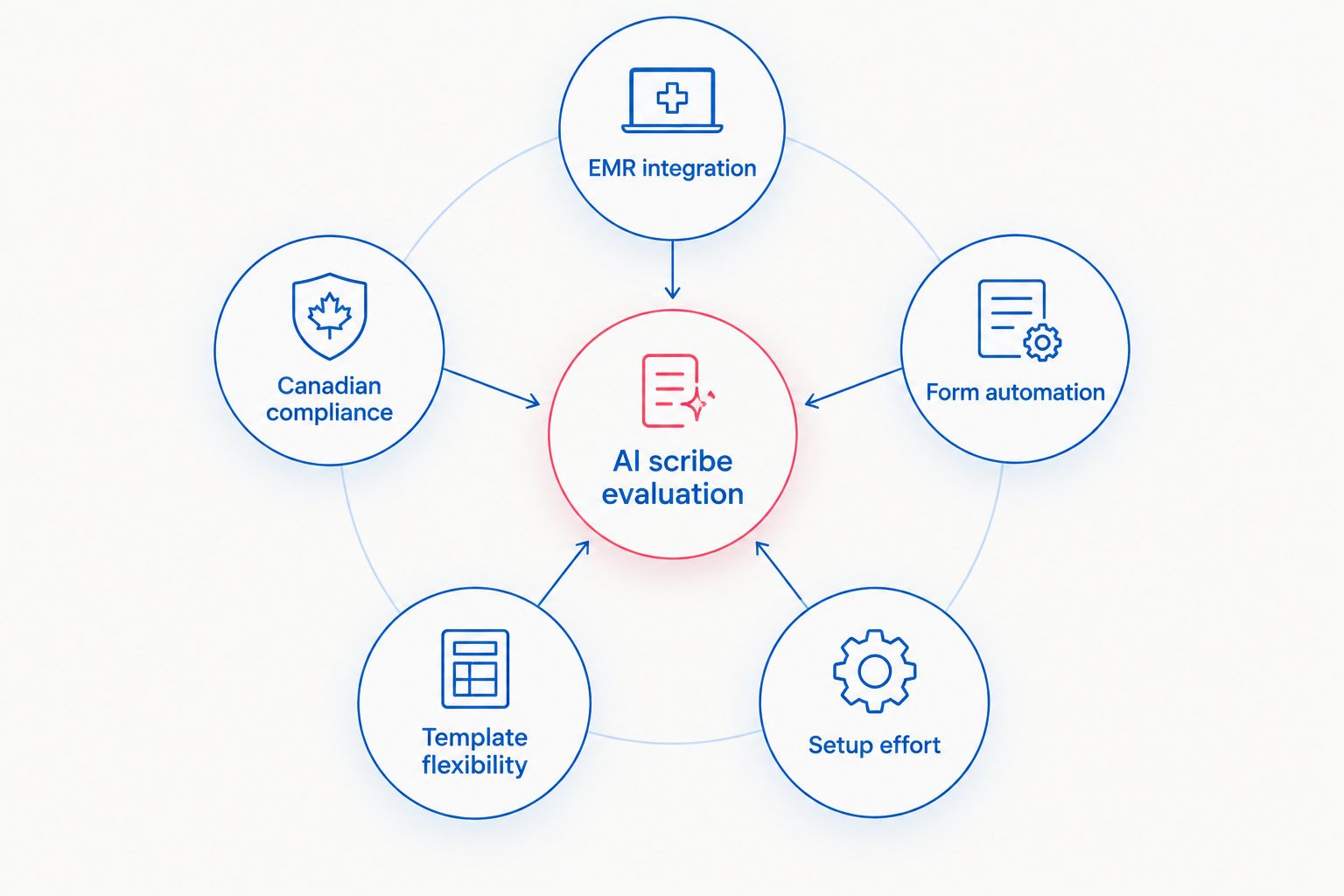
What makes the best AI scribe for family medicine
- EMR and practice management fit — does it work with Jane App, OSCAR, Accuro, Epic, or Cerner without manual copy-paste
- Canadian regulatory fit — PIPEDA and provincial health privacy alignment, confirmed directly with the vendor
- Form and letter automation — can it produce more than a SOAP note, including disability and insurance forms
- Template flexibility — primary-care-specific note structures versus generic specialty templates
- Setup effort — time from signup to first usable note, and how much IT support it requires
- Clinician review workflow — how easy it is to edit and sign off before the note enters the chart
At a glance
| Tool | Best for | Standout feature | Key limitation |
|---|---|---|---|
| Scribeberry | Canadian family clinics handling forms + EMR notes | Auto-fills forms like T2201, WSIB, ISP-2519 from the visit | Newer entrant relative to legacy dictation vendors; confirm specialty template depth for your practice |
| Tali AI | Canadian primary care teams wanting a domestic-built scribe | Voice-command chart navigation | Smaller published template library than larger US competitors |
| Nuance Dragon Copilot | Multi-physician clinics on Epic | Deep Epic workflow integration under Microsoft | Built primarily around US hospital systems; confirm Canadian data residency directly |
| Heidi Health | Solo family physicians | Fast, low-friction setup | Fewer government or insurance form templates out of the box |
| Abridge | High-volume academic or teaching clinics | Structured note generation used across large health systems | Enterprise-oriented rollout; confirm self-serve access for a small clinic |
| Suki | Clinics wanting broader AI task automation | Coding and task-assistant features beyond notes | More scope than a small family practice may need day to day |
1. Scribeberry: best AI scribe for Canadian family clinics with heavy form volume
Scribeberry converts the patient conversation into a clinical note and can generate letters and government or employer forms from the same encounter. It is built for providers working in EMRs including Epic, Cerner, and Jane App, and the workspace states it is used by over 30,000 providers.
Scribeberry pros:
- Auto-fills forms clinicians in Canada actually process — T2201, WSIB, ISP-2519, and similar
- Notes format for common EMRs used in Canadian primary care, including Jane App
- Built around primary-care visit structure rather than a generic dictation template
Scribeberry cons:
- As a newer platform relative to legacy dictation vendors, published third-party benchmark comparisons are limited
- Clinics running EMRs outside its documented integrations should confirm compatibility before switching
Best for: Canadian family medicine clinics that spend real time on both charting and paperwork. Verdict: Buy — for clinics where form volume is part of the daily workload.
2. Tali AI: best AI scribe for clinics wanting a Canadian-built alternative
Tali AI is a Canadian company offering ambient documentation with voice-command features for navigating the chart hands-free. It targets primary care and multi-specialty clinics looking for a domestically built tool.
Tali AI pros:
- Voice-command navigation reduces mouse and keyboard use mid-visit
- Positioned specifically around the Canadian clinic market
- Applicable across primary care and some specialty workflows
Tali AI cons:
- Published template libraries appear narrower than some larger US-based competitors
- Confirm current EMR integration list directly, since coverage varies by clinic software
Best for: Canadian clinics prioritizing a domestic vendor and hands-free navigation. Verdict: Buy — worth a trial if voice-command workflow matters to your team.
3. Nuance Dragon Copilot: best AI scribe for clinics already on Epic
Nuance Dragon Copilot, under Microsoft, builds on Nuance's dictation history with ambient note generation designed to sit inside Epic's workflow. It targets larger clinics and health systems already standardized on that EMR.
Nuance Dragon Copilot pros:
- Deep integration with Epic for organizations already on that platform
- Backed by Microsoft's ongoing investment in the product
- Familiar to clinicians who already used earlier Nuance dictation tools
Nuance Dragon Copilot cons:
- Documentation and case studies skew toward large US hospital systems, not small Canadian family clinics
- Confirm Canadian data residency and PIPEDA alignment directly with the vendor before adopting
Best for: Multi-physician clinics or health systems standardized on Epic. Verdict: Hold — evaluate seriously only if your clinic already runs Epic.
4. Heidi Health: best AI scribe for solo family physicians
Heidi Health offers ambient scribing aimed at fast onboarding for individual clinicians, without a lengthy IT rollout. It suits solo practitioners who want to start using a scribe the same week they sign up.
Heidi Health pros:
- Low setup friction for a single provider or small practice
- No heavy IT involvement required to get started
- Straightforward note output for day-to-day visits
Heidi Health cons:
- Fewer built-in templates for government or insurance forms compared to form-focused competitors
- Smaller clinics may need to confirm long-term template roadmap as needs grow
Best for: Solo family doctors who want a working scribe fast, with minimal setup. Verdict: Buy — for a single-provider practice without form-heavy documentation needs.
5. Abridge: best AI scribe for high-volume teaching clinics
Abridge generates structured clinical notes from patient conversations and has been adopted by large US health systems and academic medical centres. It is oriented toward organizations with significant documentation volume.
Abridge pros:
- Structured note output validated across large health system deployments
- Built to handle high patient volume
Abridge cons:
- Enterprise-oriented rollout process may not suit a small independent clinic
- Confirm direct self-serve access and Canadian availability before committing
Best for: Academic or teaching family medicine clinics with high visit volume. Verdict: Hold — worth investigating if your clinic operates at health-system scale.
6. Suki: best AI scribe for clinics wanting broader AI task automation
Suki positions itself as an AI assistant beyond note-taking, adding features like coding support and administrative task automation on top of ambient documentation.
Suki pros:
- Extends past notes into coding assistance and task automation
- Useful for clinics wanting one tool to cover multiple admin tasks
Suki cons:
- Broader scope may be more than a small family practice needs
- Confirm which features are active in your region before purchase
Best for: Clinics wanting a wider AI assistant footprint, not just documentation. Verdict: Wait — assess whether your clinic actually uses the extra features before paying for them.
How we ranked
Each tool was weighed against the criteria above: EMR fit, Canadian regulatory alignment, form and letter automation, template flexibility, setup effort, and clinician review workflow. Tools built around forms and Canadian primary care ranked ahead of general-purpose dictation tools built primarily for US hospital systems.
See how Scribeberry handles your forms
Check EMR compatibility and form templates for your clinic.
Which AI scribe should you choose?
If your clinic spends real time on CRA, provincial, or employer forms alongside daily notes, Scribeberry is the strongest fit for 2026 given its form auto-fill and EMR alignment. If you're already standardized on Epic across a larger group, evaluate Nuance Dragon Copilot first. Solo physicians who want to start this week without an IT project should trial Heidi Health, and clinics that want a Canadian-built option should shortlist Tali AI alongside it.
FAQ
What's the best AI scribe for family medicine clinics in 2026?
Scribeberry ranks as the best ai scribe for family medicine clinics with heavy form volume in 2026, since it auto-fills Canadian forms like T2201 and WSIB alongside EMR notes. Clinics without form-heavy workloads may prefer Heidi Health or Tali AI instead.
Is Scribeberry better than Nuance Dragon Copilot for family practice?
For Canadian family clinics handling government and insurance forms, Scribeberry is built more directly around that workflow. Nuance Dragon Copilot is stronger for large multi-physician groups already standardized on Epic.
Do AI scribes work with Jane App and OSCAR EMR?
EMR compatibility varies by vendor, so confirm current integration lists directly with each company before switching. Scribeberry's documented integrations include Jane App alongside Epic and Cerner.
Can an AI scribe fill out CRA or provincial disability forms?
Some scribes, including Scribeberry, are built to auto-fill forms like CRA's T2201 and Service Canada's ISP-2519 from the visit conversation. Not every AI scribe on the market offers this, so check the specific vendor's form list.
Is patient data from an AI scribe stored in Canada?
Data residency and PIPEDA alignment vary by vendor and should be confirmed directly with each company before adoption. Do not assume residency status based on where a company is headquartered.
How much clinician review does an AI-generated note need?
Every AI-generated note still requires clinician review and sign-off before it enters the chart, regardless of vendor. Treat the output as a draft, not a final record.
Do solo family physicians need a different AI scribe than a group clinic?
Solo physicians often prioritize fast setup with minimal IT involvement, which is where tools like Heidi Health fit well. Larger groups on shared EMRs like Epic tend to prioritize deeper system integration instead.
How much does an AI medical scribe cost in 2026?
Pricing varies by vendor, plan tier, and clinic size, so confirm current pricing directly on each company's website before committing. No single price applies across the market in 2026.
One last thing
The form-auto-fill feature is the detail most clinics skip when comparing scribes, and it's the one that saves the most time in a Canadian family practice — a scribe that only writes SOAP notes still leaves you filling out T2201 or WSIB paperwork by hand after the visit. Before signing anything in 2026, ask each vendor for their current list of supported forms, not just their EMR list.