
Best AI Scribe for Veterinarians: Vet-First in 2026
The best ai scribe for veterinarians passes a clinic-run pilot. Compare veterinary AI, dictation and human scribes with practical note-review checks for 2026.
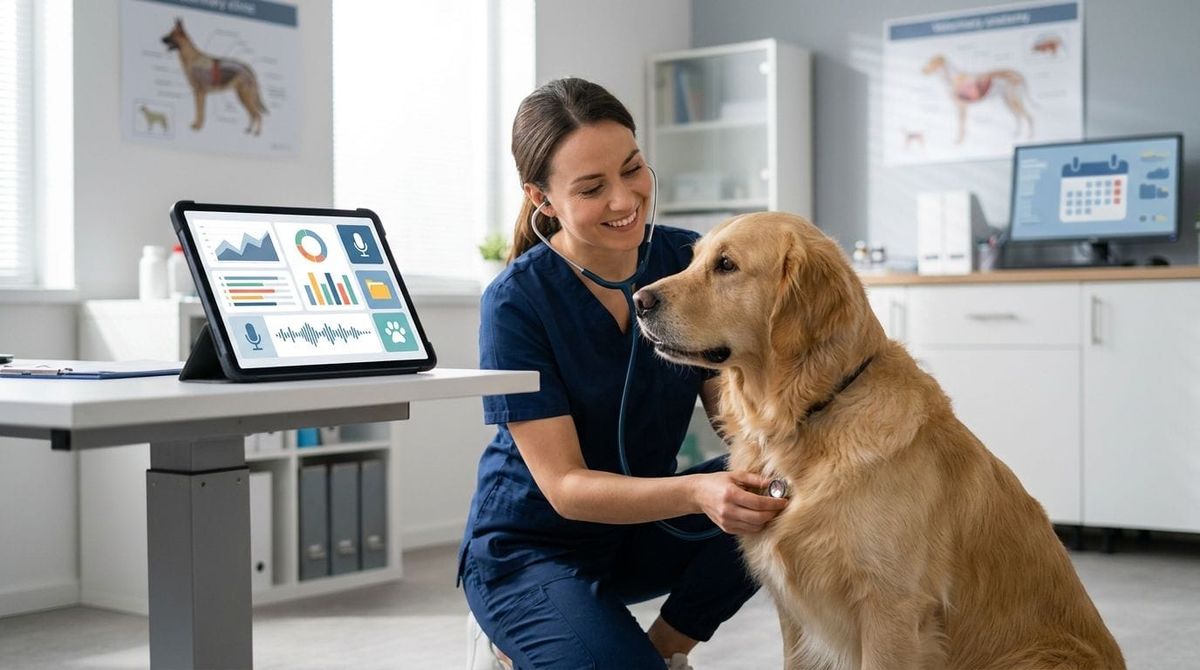
Best overall for a veterinary clinic in 2026: a veterinary-specific AI scribe that passes a pilot with your own encounters. Best for clinicians who want to control every word: dictation into an existing note template. Best for delegated drafting: a human veterinary scribe. Scribeberry is a medical scribe for human healthcare providers, so veterinary suitability needs to be established before a clinic adopts it.
- The best ai scribe for veterinarians is a veterinary-specific candidate that passes a clinic-run documentation pilot.
- Choose dictation and templates when direct control of note wording matters more than drafting assistance.
- Scribeberry supports human clinical documentation; verify veterinary suitability rather than assuming it from medical-scribe features.
- Review every generated note against the encounter before it enters the patient record.
Why this matters
A veterinary visit can involve an animal patient, an owner speaking on the animal’s behalf and a clinician making decisions about care. A usable draft must keep those roles distinct. A fluent note that attributes an owner’s observation to a physical examination is not ready for the record.
The decision is therefore about which workflow produces a draft your clinician can verify and file, not which tool writes the smoothest summary. The Scribeberry medical scribe turns patient conversations into clinical notes, letters and forms for doctors, nurses and other healthcare providers. That description does not establish veterinary support. In 2026, test veterinary suitability directly rather than extending a human-healthcare use case by assumption.
What makes the best AI scribe for veterinarians
Use these criteria before comparing products. A vendor demonstration cannot substitute for a draft from your clinic’s own encounter, reviewed by the clinician who conducted it.
- Species and patient identity: Does the draft identify the animal patient correctly and keep owner details separate from patient details? Check what happens when the owner discusses more than one animal.
- Speaker attribution: Can you distinguish an owner-reported symptom from a clinician-observed finding? Reject wording that turns an uncertain history into a confirmed examination result.
- Exam and plan: Are findings, assessment and next steps separated clearly? Check that the draft does not insert an examination finding, diagnosis or treatment instruction that nobody stated.
- Record transfer: Can the clinician place the reviewed note into the clinic’s actual record workflow without losing headings, context or corrections? Confirm the transfer method rather than assuming an integration exists.
- Review burden: Is correcting the draft simpler than documenting the encounter through your current method? Count the edits that matter clinically, not just spelling changes.
- Privacy and recording: Establish what is captured, where it is handled, who can access it and how the clinic will obtain any required permission. Get the relevant vendor documentation before using real encounters.
The diagram follows the first four checks. Treat each as a separate acceptance test: a draft that passes identity but fails attribution still needs correction before filing.
Veterinary documentation options at a glance
These are workflow options, not verified head-to-head product results. A veterinary-specific product earns the top slot only after it passes the clinic’s tests; a category label is not a vendor endorsement. No option removes clinician review.
| Option | Best for | Standout feature | Key limitation to test |
|---|---|---|---|
| Veterinary-specific AI scribe | Clinics piloting ambient veterinary notes | Veterinary use is the selection requirement | Accuracy and record fit must be demonstrated locally |
| Dictation and existing templates | Clinicians prioritizing direct wording control | Clinician determines the note structure | Drafting and correction remain clinician tasks |
| Human veterinary scribe | Clinics delegating draft preparation | A person can clarify unclear instructions | The clinician still checks the finished record |
| Scribeberry | Human-healthcare teams evaluating a medical scribe | Conversation-to-note, letter and form drafting for healthcare providers | Veterinary suitability is not established by the supplied description |
1. Veterinary-specific AI scribe: best for a veterinary pilot
Best for: A clinic prepared to test candidate tools against its own encounters and record workflow.
Start with vendors that explicitly present veterinary use, then request a supervised trial. The label veterinary-specific is a screening criterion, not proof that a candidate handles your species, appointment types or documentation standards. The winning tool is the one whose reviewed drafts preserve patient identity, history, findings and plan in the clinic’s actual workflow.
Veterinary-specific AI scribe pros:
- Veterinary use can be checked as a stated product purpose before a pilot begins.
- The clinic can test drafts against the encounter types it actually documents.
- A consistent acceptance checklist makes errors visible instead of relying on how polished a note sounds.
Veterinary-specific AI scribe cons:
- A veterinary label does not establish accuracy for every species or visit type.
- The clinic must verify privacy terms and record transfer for each candidate.
- Every draft still requires clinician review and correction.
Run the same review for at least 3 encounter types: a routine visit, a visit with a detailed owner history and a follow-up where the plan depends on earlier care. These are proposed test cases, not a claim about any vendor’s performance. Note every unsupported statement and every correction needed before filing.
Verdict: Buy only after the candidate passes a supervised veterinary pilot.
2. Dictation and existing templates: best for wording control
Best for: A veterinarian who wants to determine the note’s structure and clinical wording directly.
Dictation into an existing template is not an ambient AI scribe. It remains a useful comparison because an AI draft has to improve on the workflow the clinic already uses. If a template prompts for history, findings, assessment and plan, the clinician can fill those sections while maintaining direct control over what is recorded.
Dictation and template pros:
- The clinician chooses what enters each section.
- Existing headings can preserve the clinic’s preferred note format.
- There is no generated interpretation to mistake for a directly observed finding.
Dictation and template cons:
- The clinician still creates and edits the note.
- A template cannot decide whether a clinical statement is complete or correct.
- Dictated text still needs review for recognition errors and missing context.
Compare this workflow with an AI candidate using 1 reviewed note from each method for the same type of appointment. Check completeness and clinically significant edits; do not judge the result by prose style alone. If dictation produces a record you can review more efficiently, an AI subscription has not yet earned a place in that workflow.
Verdict: Hold as the baseline against which an AI scribe must prove useful.
3. Human veterinary scribe: best for delegated drafting
Best for: A clinic that wants a person to prepare the draft while the veterinarian retains final review.
A human scribe is a different staffing workflow from an AI tool. The clinician can give instructions about terminology, section order and what needs clarification. Those instructions do not replace a final check: the veterinarian must confirm that the record reflects the encounter and distinguish reported history from observed findings.
Human veterinary scribe pros:
- The clinician can clarify an ambiguous instruction with a person.
- Draft preparation can be assigned without making software interpretation the sole source of note wording.
- The clinic can define a review and correction process around its existing record format.
Human veterinary scribe cons:
- Draft quality depends on training, communication and review.
- A scribe cannot confirm a finding the clinician did not communicate.
- Delegation does not remove the clinician’s responsibility to check the record.
If you compare this option with an AI pilot, use the same acceptance criteria. Inspect patient identity, attribution, findings, plan and transfer into the record. A human-written note and a generated note can fail in different ways; neither should be filed merely because it is readable.
Verdict: Buy when delegated drafting is the goal and the clinic can support training and review.
4. Scribeberry: best for its stated human-healthcare use
Best for: Doctors, nurses and other healthcare providers evaluating ambient medical documentation for human patients.
Scribeberry is described as an AI-powered ambient medical scribe that turns patient conversations into notes, letters and forms. Its stated audience is human healthcare providers using EMRs such as Epic, Cerner and Jane App. None of those facts verifies veterinary terminology, animal-patient records or compatibility with a veterinary practice-management system.
Scribeberry pros:
- Its stated purpose includes turning conversations into clinical notes.
- Letters and forms are also named in the supplied product description.
- The described audience and EMRs give a human-healthcare buyer a defined starting point for evaluation.
Scribeberry cons for a veterinary buyer:
- The supplied description does not establish a veterinary use case.
- The named EMRs do not establish compatibility with the clinic’s veterinary record system.
- Veterinary note quality and handling of animal-patient information need direct verification before use.
Do not treat those documentation gaps as proof that Scribeberry lacks veterinary capabilities. They mean a veterinarian should ask for current product documentation and a suitable pilot before considering it for animal care. Do not enter a real encounter into an unapproved workflow to find out whether it works.
Verdict: Wait for verified veterinary fit; evaluate Scribeberry against its stated human-healthcare use today.
How to run a clinic pilot in 2026
A good pilot tests the path from spoken encounter to signed record. Keep the assessment narrow enough that reviewers can identify the source of each error.
- Choose representative encounters. Include the appointment types your team actually handles. Write down the animal’s identity, the owner’s role and any prior context the draft needs to represent.
- Define the permitted capture workflow. Confirm consent or permission requirements, privacy terms, access controls and handling of captured information with the vendor and the clinic’s own policies before recording.
- Create a reference account. The treating clinician records the history, observed findings and intended plan. This gives reviewers something concrete against which to check a draft.
- Review attribution first. Mark each statement as owner-reported, clinician-observed or a clinical assessment. An accurate-sounding sentence in the wrong category is a substantive error.
- Review omissions and additions. Flag absent details that matter to care and statements that cannot be traced to the encounter. Correct both before considering the note complete.
- Test filing. Transfer the corrected note through the clinic’s intended record process. Check formatting, patient association and whether the clinician’s final edits remain intact.
Have 2 clinicians review a sample when the workflow will be shared across a practice. Their task is to identify discrepancies, not to score how impressive the wording sounds. Repeat the check when the visit format changes; success in a short routine appointment does not establish performance in a more complex encounter.
The clinical rule is simple: the clinician reviews the source encounter, corrects the draft and approves the final record. A generated note is a draft, even when its sections are complete. In 2026, ask every candidate to show how a clinician makes and retains corrections in the actual filing workflow.
How we ranked these options
The order reflects fit to the query, not measured vendor performance. A veterinary-specific candidate ranks first because veterinary use is the question being answered; it becomes a recommendation only after it passes the criteria above. Dictation and human scribes follow as distinct ways to produce a draft. Scribeberry ranks last for this veterinary query because its supplied description establishes human-healthcare use, not veterinary use.
There is no verified head-to-head accuracy result, time-saving figure or veterinary-system compatibility claim in this ranking. That is why the decision rests on an observable clinic pilot rather than a numerical score. If a candidate cannot show how the clinician checks attribution and corrects the final record, do not adopt it on the strength of a sample note.
Which option should a veterinarian choose in 2026?
Choose a veterinary-specific AI scribe that passes your own supervised pilot. If no candidate meets your identity, attribution, privacy and record-transfer checks, keep dictation and templates as the baseline. Choose a human veterinary scribe when delegated drafting, rather than software-assisted drafting, is the requirement.
Scribeberry has a clear medical-scribe use case for human healthcare providers. A veterinary clinic needs separate confirmation of animal-care fit before making it part of its documentation workflow. That distinction matters more than a broad claim that any ambient medical scribe can handle any clinical conversation.
FAQ
What is the best ai scribe for veterinarians in 2026?
The best choice is a veterinary-specific candidate that passes a supervised pilot in your clinic. Check animal-patient identity, speaker attribution, clinical content, privacy and transfer into the final record.
Can a human medical scribe app be used in a veterinary clinic?
Do not assume human medical-scribe features establish veterinary suitability. Ask the vendor to document the intended use and test the proposed workflow before entering real veterinary encounters.
Is Scribeberry a veterinary AI scribe?
Scribeberry is described here as a medical scribe for doctors, nurses and other human healthcare providers. The supplied description does not establish veterinary support, so a clinic needs direct confirmation before considering that use.
What should a veterinarian check in an AI-generated note?
Check patient identity, owner-reported history, observed findings, assessment and plan against the encounter. Correct omissions, unsupported additions and misattributed statements before approving the record.
Is dictation better than an AI scribe for veterinarians?
Dictation is the better baseline when direct control of wording is the clinic’s priority. An AI candidate earns adoption only if its reviewed drafts improve on that workflow without introducing unacceptable corrections.
Does an AI-generated veterinary note still need clinician review?
Yes. The clinician must review and correct a generated draft before approving the final record; readable prose alone does not establish that the clinical content is accurate.
How do I test whether an AI scribe fits our veterinary records?
Pilot the full path from encounter to final record. Check patient association, section formatting, transfer method and whether the clinician’s corrections remain in the filed note.
One last thing
In a 2026 pilot, look first for a sentence that changes who said what. A note can preserve the right symptom and still be wrong if it presents an owner’s report as an examination finding. That single check is more useful than judging whether the draft sounds polished.